
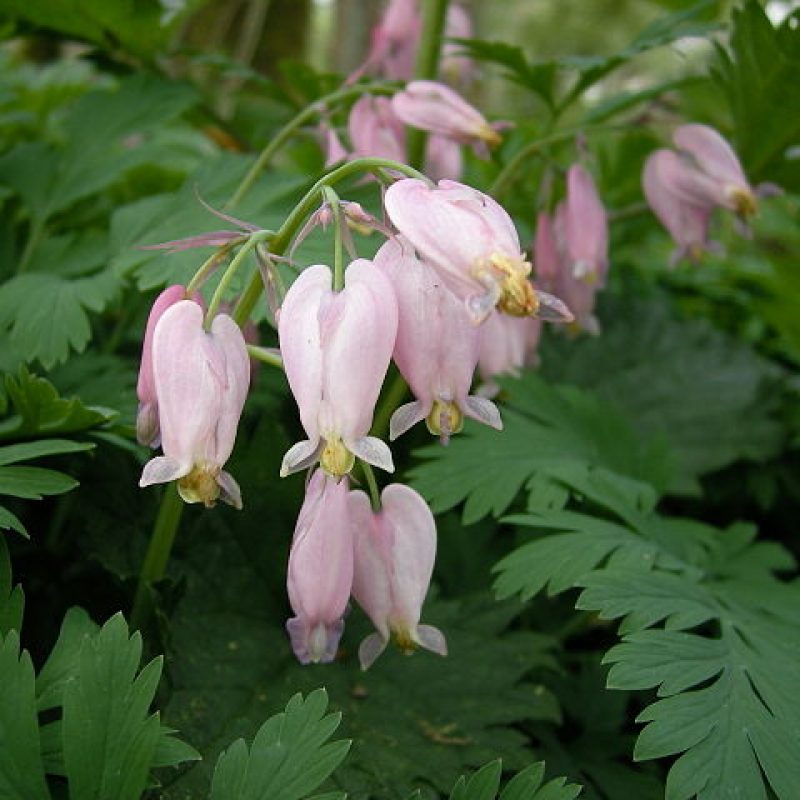
By now, you’ve started seeing the early leaves of our lovely delicate Pacific Bleeding Heart. This species is the Northwest’s native species of Dicentra. MANY people have other horticultural varieties in their gardens, generally picked up at some of the big box stores around the area. Those are beautiful, however, they are generally larger and more vibrantly pink and white. The Pacific Bleeding Heart spreads through forest floors creating the one of the first ground level green layers of foliage that welcome the Spring. Their rhizomes spread a little more each year and if you’re lucky you’ll be privy to a wonderous light green expansive carpet of ferny leaves that promise a lovely blooming carpet of dainty pink and white heart shaped flowers on long stems that reach up to expose their flowers to passersby. Ahhhh the PNW forests, truly a spectacular place to be.
But what do they bring to the natural world or those who are interested in plants for a myriad of purposes? Let’s talk about that.
First a little ID information:
Pacific Bleeding Heart is a delicate perennial herb known for its fern-like leaves and distinctive pink, heart-shaped flowers that droop gracefully from arching stems.
Habitat:
- Found in moist, shady forests, along stream banks, and in open woodlands.
- Grows at low to mid elevations, often thriving in rich, well-drained soils with plenty of organic matter.
- Frequently seen in coastal regions and foothills of the Cascades.
Identifying Features:
- Leaves: Soft, feathery, fern-like, and deeply lobed. Light green to bluish-green.
- Flowers: Pink to purplish, heart-shaped with extended tips, dangling in small clusters from arching stems.
- Bloom Time: Spring to early summer (March to July).
- Height: Typically grows 8-18 inches tall.
- Roots: Spreading rhizomes, which allow it to form dense patches over time.
Winter Identification:
- Dies back to the ground in winter, leaving no visible above-ground growth.
- May persist longer in mild coastal areas but generally re-emerges in early spring.
Wildlife & Ecological Role:
- Pollinators: Attracts bumblebees, hummingbirds, and butterflies.
- Deer & Rabbit Resistance: Somewhat resistant due to toxic compounds in the leaves.
- Ground Cover: Helps prevent erosion in moist, shaded areas.
Similar Species:
- Western Bleeding Heart (Dicentra pauciflora) – Found in drier areas with smaller flowers.
- Fringed Bleeding Heart (Dicentra eximia) – A garden variety with more deeply fringed leaves.
What about its uses? Pacific Bleeding Heart (Dicentra formosa) has some recorded medicinal uses, primarily in Indigenous and traditional herbal medicine. However, it contains alkaloids that can be toxic in large amounts, so it must be used with caution. I do not personally work with it, as there are other options that are safer when thinking about dosages.
Traditional Medicinal Uses of Pacific Bleeding Heart
1. Pain Relief (Analgesic)
- The tubers (roots) were sometimes chewed or made into a poultice and applied to sore muscles, bruises, or injuries for pain relief.
- Some Indigenous groups used the root externally for toothaches and joint pain.
2. Sedative & Relaxant
- Small amounts of root extracts were sometimes taken to calm nerves and promote sleep.
- Used as a mild tranquilizer in traditional medicine, similar to poppies (though weaker).
3. Wound Healing
- A poultice made from crushed roots or leaves was sometimes applied to cuts and skin irritations.
4. Possible Heart & Circulatory Benefits
- Some herbalists in the past believed Bleeding Heart could have a mild effect on the heart and circulation, though this is not well-documented.
Warnings & Toxicity
- Alkaloids (like isoquinoline) in the plant can be toxic in large doses, causing nausea, dizziness, and disorientation.
- Not recommended for internal use unless under expert guidance.
- The plant is mildly toxic to pets and livestock if consumed in large amounts.
Modern Herbal Use
While it is less commonly used today in herbal medicine due to its toxicity, some herbalists still use diluted tinctures of the root for pain relief and relaxation. However, safer alternatives like valerian or California poppy are more commonly recommended.
The preparations by Indigenous peoples are something that seems to have faded into history, but we know a little bit. It’s very possible that more information is available, just not in my current sphere.
Traditional Preparation Methods:
- Poultice (External Use for Pain & Wounds)
- The root or leaves were mashed or chewed into a paste.
- Applied directly to bruises, sore muscles, or minor wounds.
- Tincture or Decoction (Internal Use for Pain & Relaxation)
- Roots were dried and ground into a powder or steeped in hot water to extract active compounds.
- A low-dose tincture (alcohol extract) was sometimes used for pain relief and relaxation.
- Only used in small amounts due to toxicity concerns.
- Chewing the Root (Mild Sedative Effect)
- Some Indigenous groups chewed small pieces of the root for toothaches or nerve pain.
- This was done cautiously, as larger doses could cause nausea and dizziness.
KEY TAKEAWAYS:
- Pacific Bleeding Heart was mainly used externally for pain relief and internally in small doses for sedation.
- It shares some properties with California Poppy (a safer sedative) and Valerian Root (a stronger sleep aid).
- Unlike Opium Poppy, it is not a narcotic, but it does contain mild pain-relieving alkaloids similar to those in Fumitory plants.
- Due to toxicity concerns, modern herbalists tend to favor California Poppy or Valerian over Bleeding Heart for pain relief and relaxation.
Here is a table of alternatives and warnings that you can consider in your studies. All of these are great plants to know when considering the pain-relieving aspects of nature’s remedies and what to or not to use in your practice.
Comparison to Other Pain-Relieving & Sedative Plants
| Plant | Traditional Use | Effects | Safety |
|---|---|---|---|
| Pacific Bleeding Heart (Dicentra formosa) | Poultice for pain, tincture for mild sedation | Analgesic, mild sedative | Mildly toxic in high doses |
| California Poppy (Eschscholzia californica) | Tea or tincture for pain, anxiety, and sleep | Mild pain relief, sedative, non-addictive | Safe, gentle sedative |
| Valerian Root (Valeriana officinalis) | Tea or tincture for muscle pain, insomnia, anxiety | Stronger sedative, muscle relaxant | Safe, but can cause grogginess |
| Western Pasqueflower (Anemone occidentalis) | Used for headaches & nerve pain | Analgesic, sedative | Can be toxic, must be prepared carefully |
| Oregon Grape (Mahonia aquifolium) | Root used for pain, digestion, and infections | Mild analgesic, antimicrobial | Safe in moderation |
| Opium Poppy (Papaver somniferum) | Potent pain reliever | Strong analgesic, narcotic | Highly addictive, regulated |
In the end, it’s been my pleasure to simply observe Dicentra formosa. I love coming across large swathes of this beautiful, graceful, delicate plant when out roaming in the woods. I don’t have to know about it to enjoy it visually and in some part of my soul. I do realize gobs of happiness when learning though, so I engage in that aspect when not in the woods just breathing in the air that lichens love.
Enjoy your Spring,
Love from the PNW
PS: Please remember to work with a medical professional before consuming or applying any medicines or remedies.
 Ministry of Making