
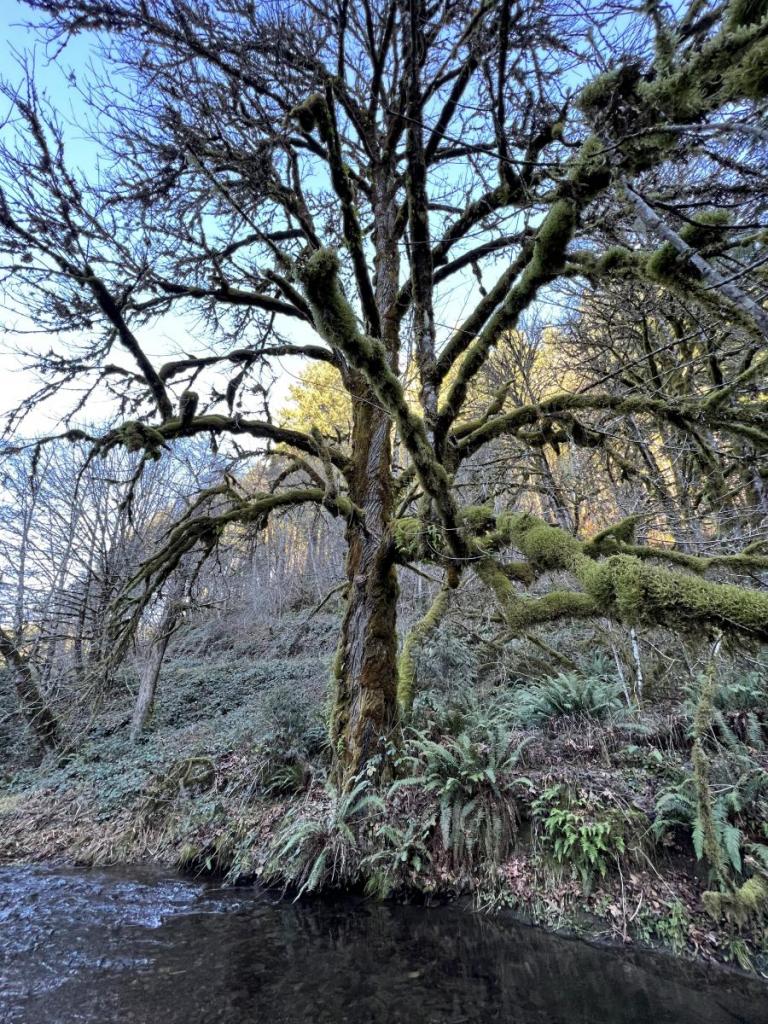
Have you had a few long months of gray and rain, perhaps looking through your window, perhaps braving the elements to get out for a wintery hike or doing some other activity outdoors? Maybe you have found yourself wondering; What is that tree or bush? If yes, then I’m hoping maybe I can help you with a few basics on identifying these delights in their sleepy wintery state. When all you have are twigs and bark, possibly some new buds, there are still indicators of the species you are looking at. Maybe this will give you some zest for getting out there before we embrace Spring in a few weeks!
In the PNW we do not have the vascular plant numbers as some places such as California. Roughly about half, there are something like 3,500 in the PNW and 7,000 in Cali. This does make a naturalist’s job easier up here and in general we have a state of abundance there are perhaps only a handful of trees and shrubs. I’m going to share with you a few that you are likely to see on any hike or lowland walk. Things can change to include more species if you start going to sub-alpine or alpine levels. They can also change if you head East of the Cascades. At this point I’m focusing on the West side of the Cascades and below sub-alpine levels. I am also omitting any horticultural varieties found in many yards on many campuses across our region.
Without leaves, we look at bark, buds, twigs, and branching patterns.
Common Evergreens of the Pacific Northwest
Most conifers in the PNW are evergreen, so needles and cones are key identifiers.
Douglas Fir (Pseudotsuga menziesii)
- Needles: Soft, single, with a slight upward curve. They have a sweet smell when crushed.
- Cones: Distinctive with “mouse tail” bracts sticking out.
- Bark: Thick, furrowed, and reddish-brown in mature trees.
Western Hemlock (Tsuga heterophylla)
- Needles: Soft, short, and uneven in length, giving a feathery look.
- Bark: Thin, reddish-brown to gray, with small ridges.
- Branches: Drooping leader (topmost branch).
Sitka Spruce (Picea sitchensis)
- Needles: Stiff, sharp, and slightly blue-green.
- Bark: Thin, gray, and flaky.
- Location: Often near coastal areas.
Western Redcedar (Thuja plicata)
- Needles: Flat, scale-like, and aromatic when crushed.
- Bark: Reddish-brown, fibrous, and peels in strips.
- Cones: Small, rosebud-shaped.
Pacific Yew (Taxus brevifolia)
- Needles: Dark green, soft, with a pointed tip. Typically, a lighter green on the underside of the needle.
- Bark: Reddish-purple, thin, and peeling.
- Berries: Red, cup-like arils instead of cones.
Common Deciduous Trees of the Pacific Northwest
Bigleaf Maple (Acer macrophyllum)
- Bark: Greenish when young, turning rough and furrowed with moss.
- Twigs: Thick with large, opposite buds.
- Keys: Often found with moss and licorice ferns growing on them.
Red Alder (Alnus rubra)
- Bark: Smooth and gray with white patches, can have a mottled appearance.
- Twigs: Reddish, with small, stalked buds.
- Keys: Small, cone-like seed pods from the previous season may still hang on.
Black Cottonwood (Populus trichocarpa)
- Bark: Light gray and smooth when young, deeply furrowed with age.
- Buds: Large, pointed, and sticky with a balsam scent.
- Keys: Often found in wet areas.
Oregon Ash (Fraxinus latifolia)
- Bark: Gray and furrowed.
- Twigs: Thick with dark, opposite buds.
- Keys: Found in wetter habitats.
Pacific Dogwood (Cornus nuttallii)
- Bark: Smooth and gray, often with small, square plates.
- Twigs: Slender with pointed buds.
Bird Cherry (Prunus padus)
- Bark: Smooth, dark gray to black, often with horizontal lenticels (lines).
- Twigs: Slender with small, pointed buds.
- Keys: Sometimes retains shriveled, black berries in winter.
Pacific Golden Willow (Salix lucida ssp. lasiandra)
- Bark: Smooth and yellowish-brown when young, becoming rough and furrowed with age.
- Twigs: Slender and yellowish to reddish in color.
- Keys: Often found in wet areas and has distinctive, flexible branches.
Vine Maple (Acer circinatum)
- Bark: Smooth and greenish when young, becoming reddish-brown with age.
- Twigs: Slender, opposite, and green to reddish.
- Keys: Often grows as a multi-stemmed, spreading shrub in shady forests. The delicate, twisting branches give it a distinctive look in winter.
Common Deciduous Shrubs of the Pacific Northwest
Red Osier Dogwood (Cornus sericea)
- Bark: Bright red to deep burgundy, especially in younger stems.
- Twigs: Slender with opposite buds.
- Keys: Found in wet areas; sometimes retains white berries in winter.
Mock Orange (Philadelphus lewisii)
- Bark: Light brown to gray, often shredding in thin strips.
- Twigs: Opposite, with small pointed buds.
- Keys: Woody seed capsules may remain from summer flowers.
Highland Cranberry (American Cranberrybush Viburnum) (Viburnum opulus var. americanum)
- Bark: Grayish-brown and smooth.
- Twigs: Opposite buds, with a reddish tint.
- Keys: May retain bright red berries through winter.
Pacific Ninebark (Physocarpus capitatus)
- Bark: Brownish and peeling in multiple layers (hence “ninebark”).
- Twigs: Slender with alternate buds.
- Keys: Found near wetlands; old dried flower clusters may persist.
Flowering Red Currant (Ribes sanguineum)
- Bark: Light brown, smooth when young, rougher with age.
- Twigs: Reddish-brown, sometimes with fine hairs.
- Keys: May retain small, shriveled dark berries.
Douglas Spirea (Hardhack) (Spiraea douglasii)
- Bark: Reddish-brown, becoming rougher with age.
- Twigs: Slender, reddish, and slightly hairy.
- Keys: Often retains dried, brown flower clusters from summer.
Salmonberry (Rubus spectabilis)
- Bark: Reddish-brown and often peeling.
- Twigs: Slender, thorny, and sometimes greenish.
- Keys: Grows in dense thickets; thorn-covered stems help with ID.
Thimbleberry (Rubus parviflorus)
- Bark: Light brown and flaky.
- Twigs: Hairy, reddish-brown, and thornless.
- Keys: Found in forest edges; broad, maple-like leaves (dried remnants may persist).
Beaked Hazelnut (Corylus cornuta)
- Bark: Smooth, grayish-brown.
- Twigs: Slender with soft hairs.
- Keys: Winter catkins (elongated flower clusters) often visible.
Common Snowberry (Symphoricarpos albus)
- Bark: Thin, light brown to gray, slightly rough with age.
- Twigs: Slender, opposite, and smooth.
- Keys: Small white berries often persist into winter, making it easy to identify.
Devil’s Club (Oplopanax horridus)
- Bark: Light brown to gray, covered in sharp, yellowish spines.
- Twigs: Thick, spiny, and rigid.
- Keys: One of the easiest shrubs to identify in winter due to its large spiny stems. Found in moist, shady forests, often near streams.
I hope this has been educational. If you would appreciate a pictorial accompaniment to this post, please let me know in the comments below. I am happy to put one together. I would simply need to go out and photograph all the aspects discussed above. Who knows, maybe I could create a fold out field guide. Ahh if only time wasn’t so incredibly short! Maybe!
Until next time, enjoy the natural gifts around you. Every step in the woods is worth five on the street. I’m pretty sure that’s how it is, right? Certainly, feels that way.
 Ministry of Making