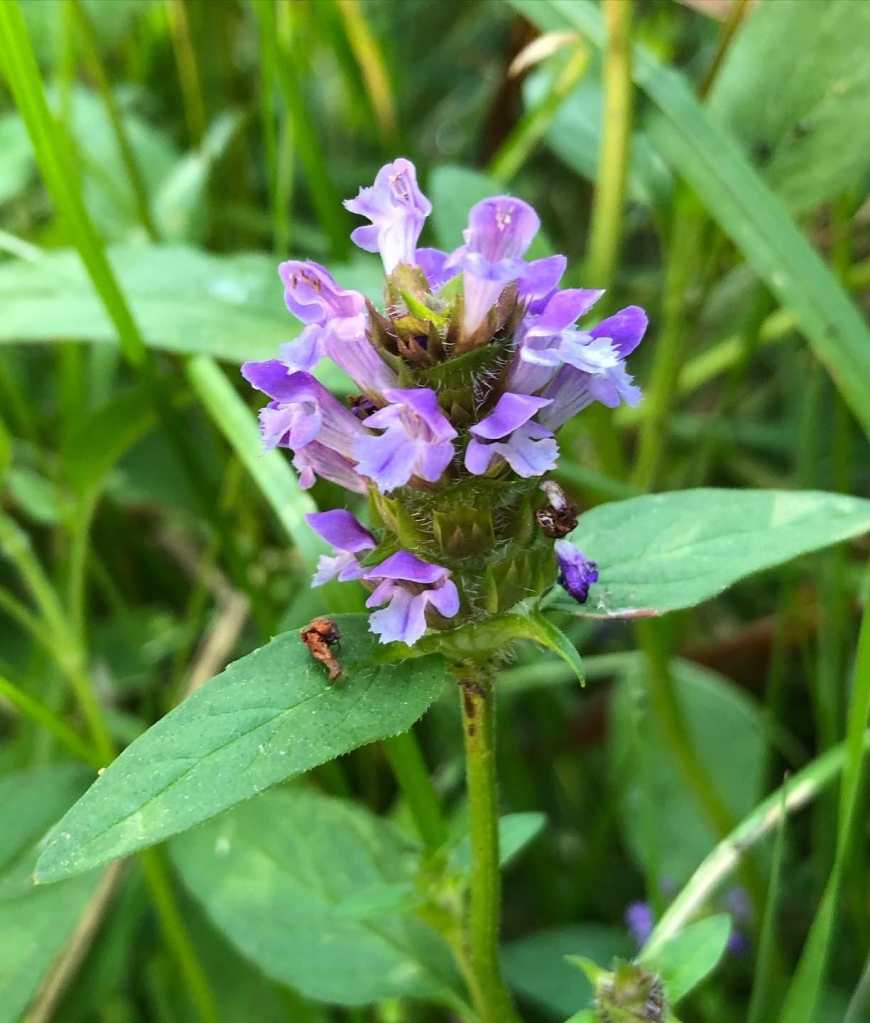
If you look around, you may be starting to see some lovely purple flowers that seem to bloom randomly along their densely packed flower spike. It seems also that they pop up in a variety of places. Yards/lawns, edges of pathways, woodland floors, etc. They have a square stem and elongated lance shaped leaves. Upright growth, but not overly tall, less than a foot in most cases.
That’s our herb! It’s a true powerhouse. Not many plants can boast immunomodulating powers packed with so many other benefits. Let’s explore that further!
Self-heal (Prunella vulgaris), also known as heal-all or woundwort, is a perennial herb that has been valued for its medicinal properties for centuries. Here are some key points about its herbal qualities:
Medicinal Properties
- Anti-inflammatory: Self-heal contains compounds such as rosmarinic acid and ursolic acid, which have anti-inflammatory properties. It can help reduce inflammation and soothe irritated tissues.
- Antioxidant: The herb is rich in flavonoids and other antioxidants, which help protect cells from oxidative stress and damage caused by free radicals.
- Antiviral: Some studies suggest that self-heal has antiviral properties and may help inhibit the replication of certain viruses, including herpes simplex virus.
- Antibacterial: Self-heal has been found to possess antibacterial properties, making it useful in treating minor wounds and infections as a skin salve or wound poultice.
- Astringent: The tannins in self-heal give it astringent properties, which can help tighten and tone tissues, making it beneficial for treating wounds and reducing bleeding.
- Immunomodulatory: Self-heal may help modulate the immune system, potentially enhancing immune response and overall health.
Traditional Uses
- Wound Healing: Historically, self-heal has been used to treat cuts, bruises, and other minor injuries. It can be applied as a poultice, salve, or wash.
- Sore Throat and Mouth Sores: Self-heal tea or gargle has been used to soothe sore throats and heal mouth sores.
- Digestive Issues: The herb has been used to treat various digestive problems, such as diarrhea and indigestion. Myself, I am wondering about it’s potential use for people that suffer with IBS. More information is needed as I have a family member that has IBS, though reasonably low level.
- Skin Conditions: Self-heal can be used topically to treat skin conditions like eczema, psoriasis, and insect bites.
Preparation and Usage
- Tea: Self-heal tea can be made by steeping the dried or fresh leaves and flowers in hot water. It can be consumed for its general health benefits or used as a gargle or rinse.
- Poultice: Fresh leaves can be crushed and applied directly to wounds, sores, or inflamed areas.
- Salve: A salve can be made by infusing self-heal in oil and then combining it with beeswax. This can be applied to the skin for healing purposes.
- Tincture: A tincture can be made by soaking the herb in alcohol, which can be used internally for its various health benefits.
Precautions
- Allergies: Some individuals may be allergic to self-heal. It’s advisable to perform a patch test before using it extensively.
- Pregnancy and Nursing: There is limited information on the safety of self-heal during pregnancy and breastfeeding. It’s best to consult a healthcare provider before using it. I think that goes without saying but be sure to listen carefully to the words used by your health care provider. There is often more to what they are saying than their words imply.
- Interactions: Self-heal may interact with certain medications. Consult with a healthcare professional if you are taking any prescription drugs.
Self-heal is a versatile herb with a long history of medicinal use. However, it’s always important to use it with caution and seek professional advice if you have any health concerns or conditions.
For the folks that are scientists or like to operate in that space now and again you may be asking: What are the compounds of self-heal that are particularly powerful and useful?
Self-heal (Prunella vulgaris) contains several bioactive compounds that contribute to its medicinal properties. Here are some of the particularly powerful compounds found in self-heal:
Phenolic Compounds
- Rosmarinic Acid: A potent antioxidant and anti-inflammatory compound. It helps protect cells from oxidative stress and has been shown to have antiviral and antimicrobial properties.
- Caffeic Acid: Another phenolic compound with antioxidant properties. It contributes to the herb’s anti-inflammatory and immune-boosting effects.
Flavonoids
- Quercetin: A flavonoid with strong antioxidant and anti-inflammatory properties. It also has antiviral and antibacterial effects. You’ve probably heard of this being used in various natural allergy relief remedies.
- Rutin: Known for its ability to strengthen blood vessels and reduce inflammation. It also has antioxidant properties.
Triterpenoids
- Ursolic Acid: A triterpenoid with anti-inflammatory, antimicrobial, and anticancer properties. It also has been shown to promote wound healing and protect the skin.
- Oleanolic Acid: Another triterpenoid with anti-inflammatory and hepatoprotective (liver-protecting) effects. It also has antimicrobial properties.
Polysaccharides
- Prunellin: A polysaccharide that has been shown to have immunomodulatory effects, enhancing the immune response and potentially protecting against infections.
Volatile Oils
- Thymol: An essential oil component with strong antiseptic, antifungal, and antibacterial properties.
- Caryophyllene: A sesquiterpene that has anti-inflammatory and analgesic (pain-relieving) properties.
Tannins
- Ellagic Acid: A tannin with antioxidant and anticancer properties. It also has antiviral and antibacterial effects.
Other Compounds
- Betulinic Acid: A compound with anticancer, anti-inflammatory, and antiviral properties.
- Salicylic Acid: Known for its ability to relieve pain and reduce inflammation. It is also used in treating skin conditions like acne and warts.
These compounds work synergistically to give self-heal its wide range of medicinal properties, including anti-inflammatory, antioxidant, antiviral, antibacterial, and wound-healing effects. The presence of these bioactive compounds makes self-heal a valuable herb in traditional and modern herbal medicine.
Do you have self-heal in front of you, or is it something else? ID is important!
A plant often confused with self-heal (Prunella vulgaris) is Bugleweed (Ajuga reptans). Here are some distinguishing characteristics between the two:
Self-Heal (Prunella vulgaris)
- Growth Habit: Forms low-growing rosettes with erect flowering stems.
- Leaves: Opposite, ovate to lanceolate, with a slightly toothed margin.
- Flowers: Small, tubular, and usually violet or purple, arranged in a dense spike or cluster at the top of the stem.
- Stem: Square-shaped, which is characteristic of many members of the mint family (Lamiaceae).
Bugleweed (Ajuga reptans)
- Growth Habit: Forms dense mats or carpets on the ground, spreading via runners (stolons).
- Leaves: Opposite, oblong to spatulate, often with a slightly wavy or scalloped margin. Leaves may have a glossy appearance.
- Flowers: Small, tubular, and typically blue or purple, arranged in a spike-like inflorescence. Flowers are usually larger and more spread out compared to self-heal.
- Stem: Also square-shaped, aligning with the mint family characteristics.
Key Differences
- Growth Pattern: Self-heal tends to grow in a more upright fashion, while bugleweed spreads horizontally, creating a dense ground cover.
- Leaf Shape and Texture: Self-heal leaves are more lanceolate and slightly toothed, whereas bugleweed leaves are broader, glossier, and can have a wavy margin.
- Flower Arrangement: Self-heal has a denser cluster of flowers at the top of the stem, while bugleweed flowers are more spaced out along the spike.
Habitat
Both plants are commonly found in similar habitats, such as lawns, meadows, and woodland edges, which can contribute to the confusion. However, their growth habits and leaf characteristics can help in correctly identifying them.
Knowing these differences can aid in proper identification and ensure the correct use of these plants, especially in herbal applications.
I tend to see Bugleweed in my area used as ground cover in landscaped areas. It has escaped the yard in a few cases, but most of our wild growing purple flowered mint family plants that look like self-heal, are in fact self-heal. Your region could be totally opposite, so make sure you know the difference.
If you are using self-heal in your home apothecary, I would love to hear about it! Please engage in the comments and let me know what you have found out about Prunella vulgaris and how you are applying its restorative and healing properties!
https://amzn.to/3LBt4el – If you are lacking this wonder plant, here is a seed packet from a business that I believe in and rely on!
 Ministry of Making