
Very recently, I led a class through one of our local parks. It was great, I met new people with like interests, they met each other, we all met the plants at our feet and on up into the sky! There was a point in which we were talking about Salmonberry, and I alluded to the fact that people aren’t really using it for medicine. However, that doesn’t mean they never did or that there aren’t some small segments of the Americas where perhaps indigenous tribes may still participate in a practice of using this lovely fruit bearing shrub. In light of all things plant education, I was able to turn up a few things of interest.
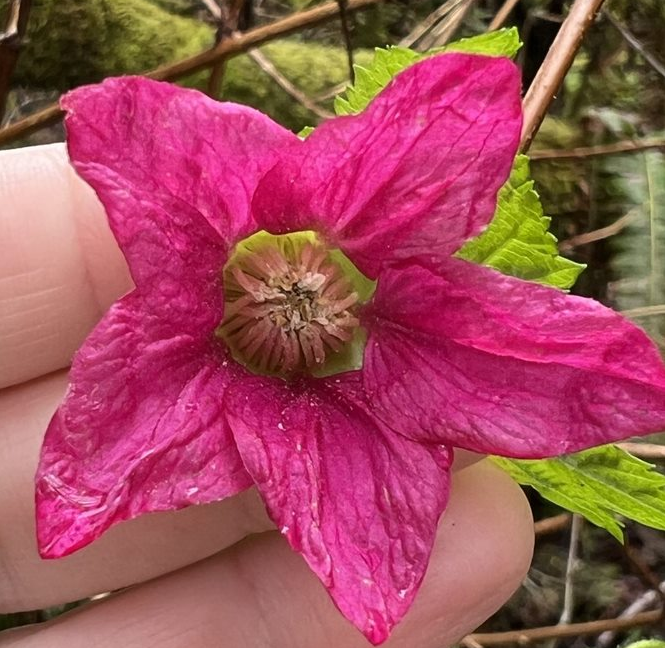
First the details on this Spring Queen: Salmonberry (Rubus spectabilis) is a species of flowering plant native to the western coast of North America, from Alaska to California. It is a member of the rose family and is closely related to raspberries and blackberries.
The plant typically grows to be 2-4 meters tall, with prickly stems and large but not too large, lobed leaves. It produces pink to orange-red flowers in the spring (I only ever see bright hot pink/fuchsia flowers), which give way to edible berries in the summer. The berries are round and resemble large raspberries but are usually more tart and less sweet. They have a reasonably large number of fine hairs coming out between the drupelets (the flesh that protect the seeds) They are typically eaten raw or used in jams, jellies, and other baked goods. They start out a sort of green, then go to gold, then orange and sometimes on to a deep crimson. Really just stunning.
Salmonberry plants are often found in wetland areas and along streams (riparian), and they are an important food source for wildlife such as bears, birds, and small mammals. Around here our Cedar Waxwings really go after them.
In addition to its culinary uses, salmonberry is also valued for its ornamental qualities. The plant’s bright pink flowers and attractive foliage make it a popular choice for landscaping and gardening. Although I find them to be pretty tenacious spreaders, so use caution if you decide to work with this plant.
Now for the even better stuff. Indigenous people used various parts of the salmonberry plant for medicinal purposes. The bark and roots were often used as a natural remedy for diarrhea, dysentery, and other gastrointestinal disorders. A poultice made from the leaves and bark was also applied topically to relieve itching and inflammation caused by skin irritations or bug bites. Additionally, the plant was believed to have astringent and antiseptic properties that could help promote healing and prevent infection.
Salmonberry was also used as a traditional remedy for women’s health issues, such as menstrual cramps and childbirth. Some indigenous groups used the leaves and bark of the plant as a natural contraceptive or to discourage pregnancy.
It is important to note that while salmonberry has been used for centuries as a medicinal plant, its effectiveness and safety for these purposes have not been extensively studied or clinically proven. As with any herbal remedy, it is important to exercise caution and consult with a healthcare professional before using salmonberry or any other natural product for medicinal purposes.
I hope this information has been useful to you. If you find a written source that discusses more about the medicinal uses of salmonberry and its various parts, I’d love to hear about it! Please leave a comment below!
https://amzn.to/3V9twod – Salmonberry seeds to try!
 Ministry of Making