
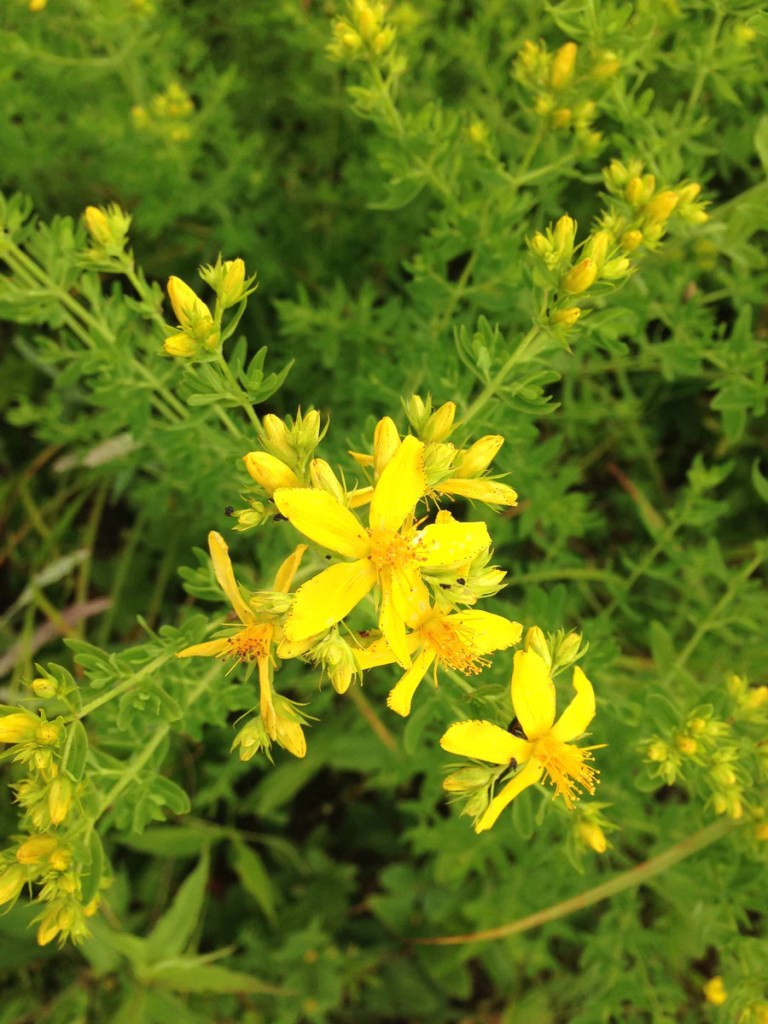
To my friend and sometimes herbal partner Doris, this one’s for you. Your adoration for this wild rangy highway “weed” is adorable. I mean why not though, with all that it has going for it, I think MORE people should appreciate its many offerings. From the ability to tell it from other plants (hint it’s in the name perforatum) to its otherwise unassuming foliage to that majorly glorious crown of bright as the sun yellow flowers, none shall resist!
St. John’s wort (Hypericum perforatum) is an herbal plant that has been used for centuries for its medicinal properties. It is native to Europe but is now widely cultivated throughout the world. St. John’s wort contains several compounds, including hypericin and hyperforin, which are believed to be responsible for its medicinal effects.
St. John’s wort has been traditionally used for a variety of conditions, including depression, anxiety, insomnia, and nerve pain. Here are some of its herbal uses:
- Depression: St. John’s wort has been used as a natural antidepressant. It is believed to work by increasing the levels of serotonin, dopamine, and noradrenaline in the brain. It may be helpful for mild to moderate depression, but should not be used as a substitute for prescribed medication for severe depression.
- Anxiety: St. John’s wort has been used to treat anxiety disorders, including generalized anxiety disorder and social anxiety disorder.
- Insomnia: St. John’s wort may help to improve sleep quality and reduce the time it takes to fall asleep. It may also be helpful for people with sleep disturbances due to depression or anxiety.
- Nerve pain: St. John’s wort may help to relieve nerve pain, including neuropathic pain and sciatica. We LOVE a good body massage oil with St. John’s Wort in it. In as high a ratio as you can fit in the herbal infusion jar!
- Skin conditions: St. John’s wort has been used topically to treat skin conditions such as wounds, burns, and eczema. Ding ding, anyone for a SALVE?
It is important to note that St. John’s wort can interact with other medications, including antidepressants, birth control pills, and blood thinners. Therefore, it is important to talk to a healthcare provider before using St. John’s wort to ensure it is safe and appropriate for your specific situation.
In Summer when you see a stand of golden flowers at your favorite hiking trail head or parking area, take a look. Are the leaves perforated (looks like little pin pricks throughout the leaf, easiest to see when the sun is shining through)? Do the flower buds leave a purple stain on your fingers when you crush them? If so, then chances are you have a local source of St. John’s Wort. Be sure the area isn’t prone to car fluid run off and isn’t sprayed. SJW LOVES to grow in disturbed areas as determined by the masses of it growing right alongside the highways. Note that when driving along at speed it is easy to confuse SJW with things such as Tansy Ragwort. I would say Scotch Broom (another yellow flowered roadside dweller) as well, but that’s an entirely different season.
If looking for a good source of St. John’s Wort for your next, tincture or salve, give Frontier Organics or StarWest a shot. I have found their quality and integrity to be admirable. However, if they are not listing any for sale at the moment, then you could try these producers. https://amzn.to/3xWY7dM
 Ministry of Making